

Open-plan offices are noisy, prone to leaking confidential information, and make it difficult to concentrate, leading more and more companies to focus on acoustic office cabins. Many people wonder: can modern acoustic office cabins truly achieve effective noise reduction? The answer is yes.
We can clearly verify this through a visually compelling video test:
Inside the acoustic office cabin, music was played, and the decibel meter showed a real-time reading of about 80dB, simulating the high-decibel environment of a typical office setting with multiple people talking. Afterwards, holding the decibel meter and stepping outside the cabin, with the door completely closed, the external decibel level dropped to about 44dB. Although this test was a demonstration of a typical scenario, not a rigorous laboratory setting with precise temperature control or frequency calibration, the nearly 36dB noise difference is still quite telling. This proves that modern soundproof office cubicles are not just a conceptual product; they can effectively reduce environmental noise, block human voice interference, and prevent the leakage of conversations, creating a quiet, independent, and private workspace for employees.
The key to effective noise reduction lies not in the exterior design, but in the combination of a composite structure and professional acoustic materials. Acoustic office cabin isn't about simply thickening a single panel; it's about creating a comprehensive sound barrier system through a combination of multi-layered sound-absorbing structures, sealed joints, high-density soundproofing materials, and laminated soundproof glass. This system cuts off both airborne and vibration-based sound transmission. For a deeper understanding of the soundproofing structure, material selection, and manufacturing processes of a 2-4 person acoustic office cabin, please read professional article: How to make an acoustic office cabin soundproof? (https://www.teleboothcn.com/news/how-to-make-an-2-4-person-acoustic-office-cabi-85507081.html), which comprehensively breaks down the core principles of soundproofing.
When purchasing a soundproof cabin, many manufacturers directly advertise soundproofing capabilities of 35dB, 40dB, or even higher. Are these figures accurate and reliable? In fact, soundproofing figures shouldn't be judged solely by surface numbers; testing standards are the key.
Professional industry-standard soundproofing performance testing must strictly adhere to international acoustic standards such as ASTM E413 and ISO 23351. It relies on a fixed laboratory environment, full-frequency sound source testing, third-party certification, and standardized testing procedures to derive accurate noise reduction parameters. As mentioned in the test video above, the 36dB noise reduction effect is only a reference figure for everyday scenarios. It is significantly affected by environmental noise, gap sealing, and the distance to the sound source, and cannot be used as an official noise reduction indicator for product design.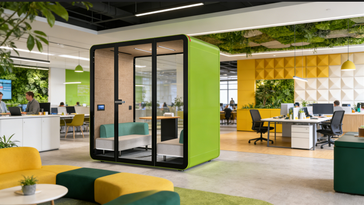
This also serves as a reminder to all purchasing companies: when assessing the sound insulation performance of soundproof enclosures, do not blindly trust promotional slogans and vague data. When inquiring, be sure to verify the product's testing basis, review authoritative third-party testing reports, and distinguish between scenario reference values and standard measured values. Only in this way can you avoid industry traps such as inflated specifications and substandard materials, and select acoustic office cabins with stable sound insulation and reliable quality.